Spanish Armada off The Isle of Wight
Back to: Antique Charts | Devon
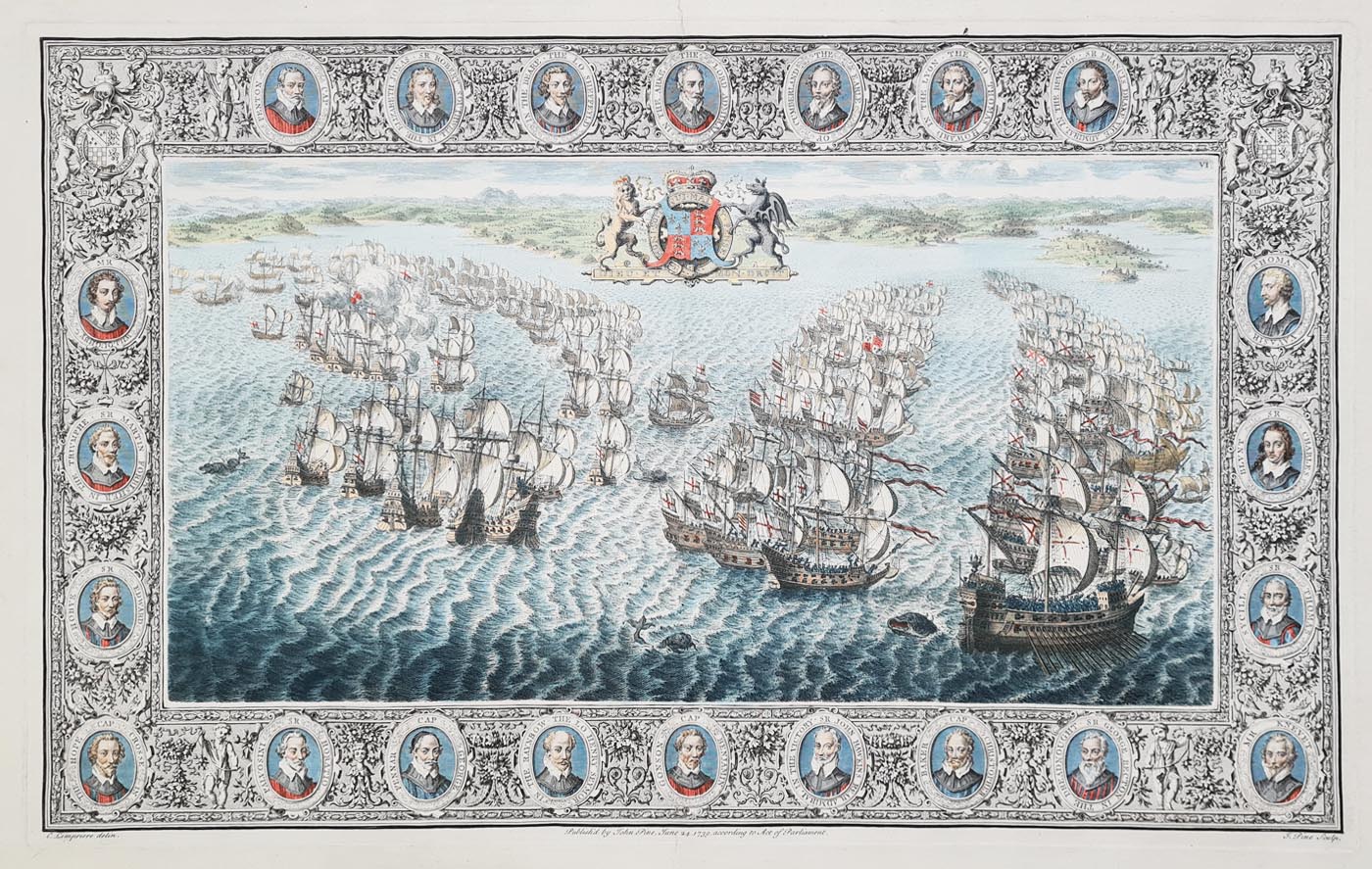
Title: Plate VI - Spanish Armada and British Fleets off the Isle of Wight.
Publication: ‘The Tapestry Hangings in the House of Lords’.
Date: 1739
Description: The Spanish Armada engaged by the British of the Dorset / Hampshire Coast, the British thwarting the intention of the Spanish to capture the Isle of Wight. From The Tapestry Hangings of the House of Lords Representing the Engagements between the English and Spanish Fleets, in the year 1588. Engraved by John Pine, Drawn by C. Lempriere and H. Gravelot. London.
Description of the engagements from Pine's 'THE TAPESTRY HANGINGS OF THE HOUSE OF LORDS. REPRESENTING THE SEVERAL ENGAGEMENTS BETWEEN THE ENGLISH AND SPANISH FLEETS'
'The Wind then shifted to the South-East, and afterwards to the South-South-West; Plate 6.whereupon a Body of English Ships, and several Merchant-Men attacked the Spanish Fleet so sharply to the Westward, that it was all forced to give way. The Lord-Admiral perceiving this, and observing at the same Time the Distress which the Triumph and the five Ships above mentioned in her Company, were in, he ordered some Ships that were then near at hand, to follow him, and to set upon the Spaniards a-fresh; and he strictly charged them, to go within Musket-Shot of the Enemy, before they discharged any one Piece of Ordnance, that they might have a better Mark, and more effectually succour the Triumph. This was immediately performed by the Ark, the Elizabeth-Jonas, the Galleon of Leicester, the Golden Lion, the Victory, the Mary Rose, the Dreadnought, and the Swallow; for in that order they proceeded. The Duke of Medina perceiving their Design, came out with sixteen of his best Galleons, to intercept the Lord Admiral, and stop him from assisting the Triumph. But, after a very sharp Conflict, the Spaniards were forced to give way, and for their greater Safety to gather themselves close into a Roundel, their best and largest Ships standing outermost, and fencing the lesser and the most battered. In this Conflict, William Coxe, Captain of a small Pinnace of Sir William Winter’s, nam’d the Delight, was slain by a great Shot, while he was bravely fighting against the Enemy.
Towards the Evening, four or five of the Spanish Vessels edged out of the South-Westward, where they were met by some of our Ships; amongst which, the May-Flower of London valiantly discharged some Pieces of Cannon at them; and, on this and other Occasions, that Ship’s Company behaved with great Resolution and Courage.
Thus the Fight continued from Morning till Night, being managed with great Bravery; but the Spaniards Shot flew, for the most part, over the Heads of the English, without doing Execution[67]; the reason of which was, that the English Ships being far less than the Enemy’s, made the Attack with more Quickness and Agility; and when they had given a Broad-Side, sheer’d off to a convenient Distance; and levell’d their Shot so directly at the larger and more unwieldy Ships of the Spaniards, as seldom to miss their Aim. Some advis’d the Lord-Admiral, with more Heat than Discretion, to grapple with and board them; but he thought it neither safe nor convenient; because the Enemy’s Fleet had a considerable Army on board, whereas ours had no such Advantage; besides their Ships far exceeded the English in Number and Bulk, and were much stronger and higher built; insomuch that their Men having the Opportunity to ply the others from such lofty Decks, must inevitably have destroyed those that were obliged, as it were, to fight beneath them. And he foresaw likewise, that the Damage and Disgrace of a total Defeat would much outweigh the Advantage of a Victory, should he happen to obtain it; since, if he was vanquished, it would have much endangered the Safety of the whole Kingdom; but if he got the better, he could obtain no more than the naked Credit of putting a Fleet in Disorder, and baffling an Enemy.——In this Day’s Engagement, a great Venetian Ship, with several other smaller ones were taken by the English.
On the 24th of July, there was but little done; the Fight being only between four great Galleasses and some English Vessels. The Spaniards, upon this Occasion had great Advantage, since their Ships had Oars, and ours, by reason of a Calm, had no use of their Sails. However, the English galled the Enemy very much with their Cannon and Chain-Shot; but at last, wanting Powder and other Necessaries to continue the Fight, the Lord Admiral sent some Vessels into the next Port for a Supply. In the mean time, a Council of War was held, wherein it was agreed, That the Fleet should be divided into four Squadrons, to be commanded, the first by the Lord Admiral himself in the Ark-Royal; the second by Sir Francis Drake in the Revenge; the third by Captain Hawkins; and the fourth by Captain Forbisher. [71]This Afternoon, his Lordship gave order, that in the Night, six Merchant-Ships out of every Squadron (as being the lightest) should set upon the Spanish Fleet in several Places at once; but it being calm all that Night, nothing could be done.'
Condition: Bird's eye view - Good image, printed from two separate copper plates, one for the decorative border with portrait vignettes and a second plate for the battle scene printed in blue ink. Later hand colouring, folding copy as published, some age discolouration to centre fold and old tape marks to top margin.
Image sizes: 365 x 600mm
14.5 x 23.75"
approx.
SOLD
Order No. 4176
John Pine

John Pine by William Hogarth
Born in London and spent his life there. Described as a cheerful, heavy-set man, he achieved remarkable success and recognition both in his career and socially, becoming London's finest heraldic and decorative engraver and producing numerous book illustrations.
In 1739 John Pine (1690–1756) published engravings of the ten Armada tapestries, together with his version of charts originally produced by Robert Adam (died 1595). In his introduction, Pine pointed to the tapestries’ national significance, describing the defeat of the Spanish Armada as, ‘the most glorious Victory that was ever obtained at Sea, and the most important to the British Nation’. The reason he gave for reproducing the tapestries was, ‘because time, or accident, or moths may deface these valuable shadows’. After the tapestries were lost in 1834, his engravings provided a unique and invaluable record.
Pine used the charts by Robert Adam, along with drawings of the central scenes in each tapestry by C. Lemprière, as source material. For the portrait heads of naval commanders in the decorative border, he worked from Hubert- Francois Gravelot’s (1699–1773) drawings. The border designs from the tapestries were closely copied in plates II, IV, VI, VIII and X. However in plates I, III, V, VII and IX Pine introduced a new border design, showing his skill working in the Tudor or later Rococo styles. He explained that this change was to add variety and to allow portraits of Sir Robert Carey, Sir Roger Townshend and Sir Thomas Gerard to be included.
A good friend of the artist William Hogarth, Pine was a fellow member of the Old Slaughter’s Coffee House on St Martin’s Lane. Together with colleagues they successfully petitioned Parliament to protect artists’ rights, resulting in the Engraving Copyright Act of 1735. Pine won a clause within it which gave him exclusive permission to reproduce the Armada tapestries. He cleverly waited until the Act was in place before proceeding with the project.
C. Lempriere a French draftsman. A ships captain, and apparently a self-taught artist, he drew views of Jersey in the Channel Islands and Lisbon which were published as engravings. He also worked with Hubert-François Gravelot on the drawings for the 16 plates published by John Pine as The Tapestry Hangings of the House of Lords. In addition, he illustrated a series of naval battles engraved by William Henry Toms.
Hubert-François Gravelot, a French illustrator, engraver, painter and draftsman was born Bourguignon and adopted the name Gravelot as a young man.
Mon - Closed
Tues-Fri 10am-1.30pm, 2.30-5.30pm
Sat 10am-1.30pm
© Devonshire Fine Art
 Free UK Mainland Delivery*
9 Church Street
Modbury
Devon PL21 0QW. UK
01548 830872